

Postural stability and risk of falling during pregnancy
During pregnancy, the female body undergoes tremendous physical, hormonal, and physiological changes. The average woman gains between 25 to 35 pounds throughout pregnancy. This sudden and localized increase in weight shifts her center of mass forward, changing her posture and may cause lower back pain. Since the risk of falling increases during pregnancy, pregnant women are often instructed to avoid activities with an increased risk of falling. However, non-strenuous work and activities while pregnant are known to favor positive outcomes. Nonetheless, 27 percent of women workers fell at least once during pregnancy. These falls account for 17 to 39 percent of all traumatic injuries to pregnant women and may result in an injury to the mother and child. These falls also lead to a large financial burden on the health care system and take an emotional toll on society. The goal of this project is to assess the influence of footwear on the risk of falling of standing pregnant women.
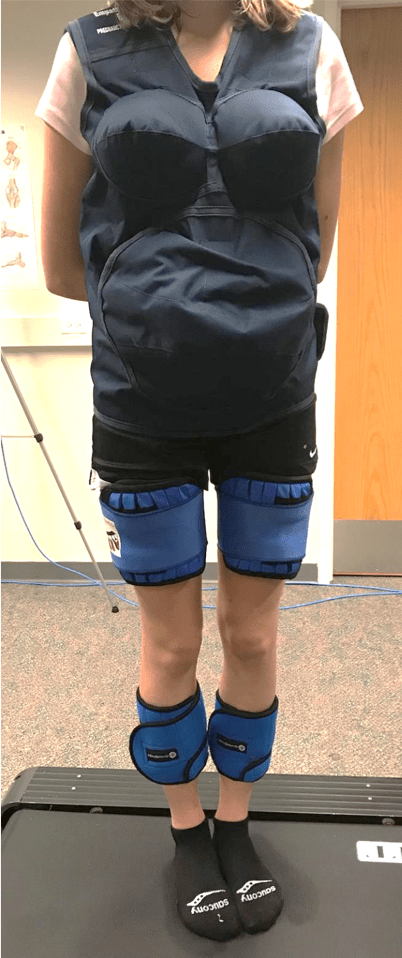
A pregnancy is simulated on non-pregnant women by locally adding weights. The influence of shoe type with and without ankle braces on the risk of falling of the subjects is measured throughout a simulated pregnancy. The risk of falling is quantified by the relative displacement of the centers of pressure and mass. Preliminary results show a good agreement between the pregnant-specific model and measured weight gains of each body segment. Results also show the risk of falling depends on the type of shoes.
Footwear effect on postural strategy and stability during quiet standing, J. Hausselle, A.G. Haddox, J. Kasitz, A. Azoug, 2021, International Biomechanics, 8(1):63-74
Morphology changes and musculoskeletal modeling of the pregnant body
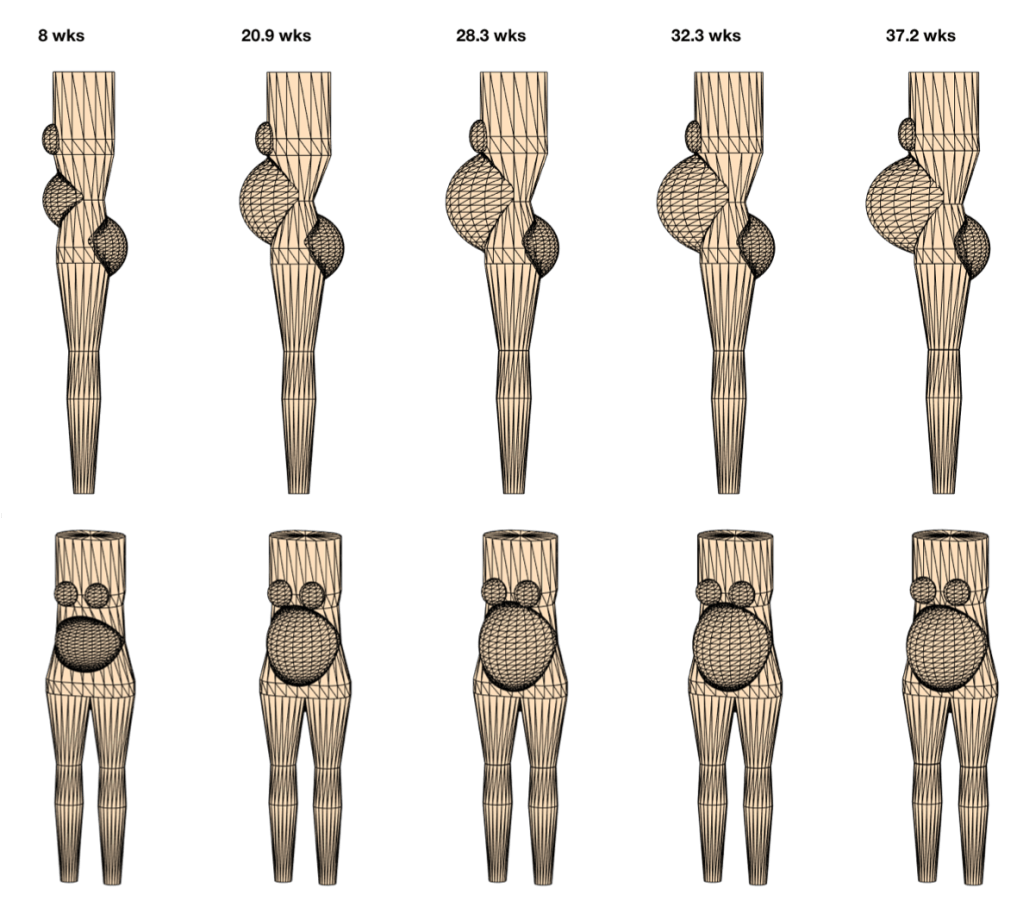
Starting from literature anthropomorphic data, we developed a model of the female body during pregnancy, correlating changes in weight and volume. The model is validated on independent measurements on pregnant women.
The Body Mass Index (BMI) of a woman increases in average by 5 during pregnancy. For a subject with known initial BMI, the model predicts the value and location of the weight gain. Hence, the model becomes a subject-specific predictor of weight changes per body segment during pregnancy.
Changes in segmental mass and inertia during pregnancy: A musculoskeletal model of the pregnant woman, A.G. Haddox, J. Hausselle, A. Azoug, 2020, Gait & Posture, 76:389-395.
Lower-back Muscle activity during pregnancy
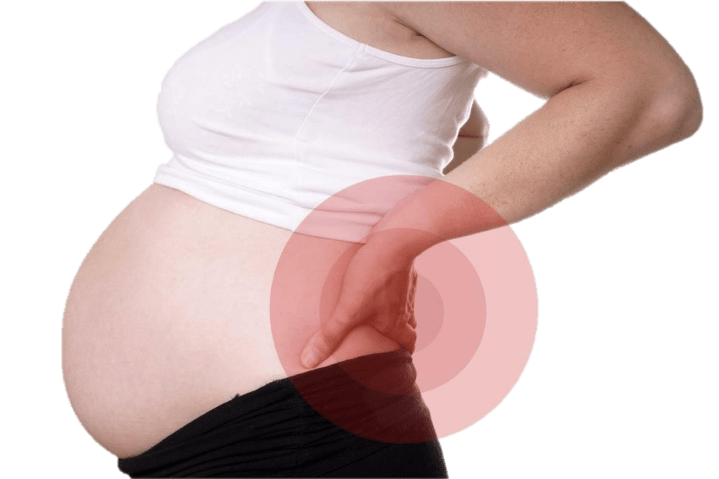
An estimated 50 to 80 percent of women experience back pain during pregnancy. This pain ranges in severity but can sometimes interfere with daily activities.
Lower back pain can start early on in pregnancy, and is typically reported between the fifth and seventh month when most changes take place. Though not the only factor, localized weight gains are quantifiable and potential causes of lower back pain during pregnancy. This study aimed at quantifying the effects of pregnancy stage and footwear condition on lower-back muscle fatigue, used as a predictor of low-back pain. Our main hypothesis was that both pregnancy and footwear condition affect lower back muscle fatigue.
 MS2M Lab